FSSAI Menu Labelling Rules, Explained: What Makes a Menu Compliant
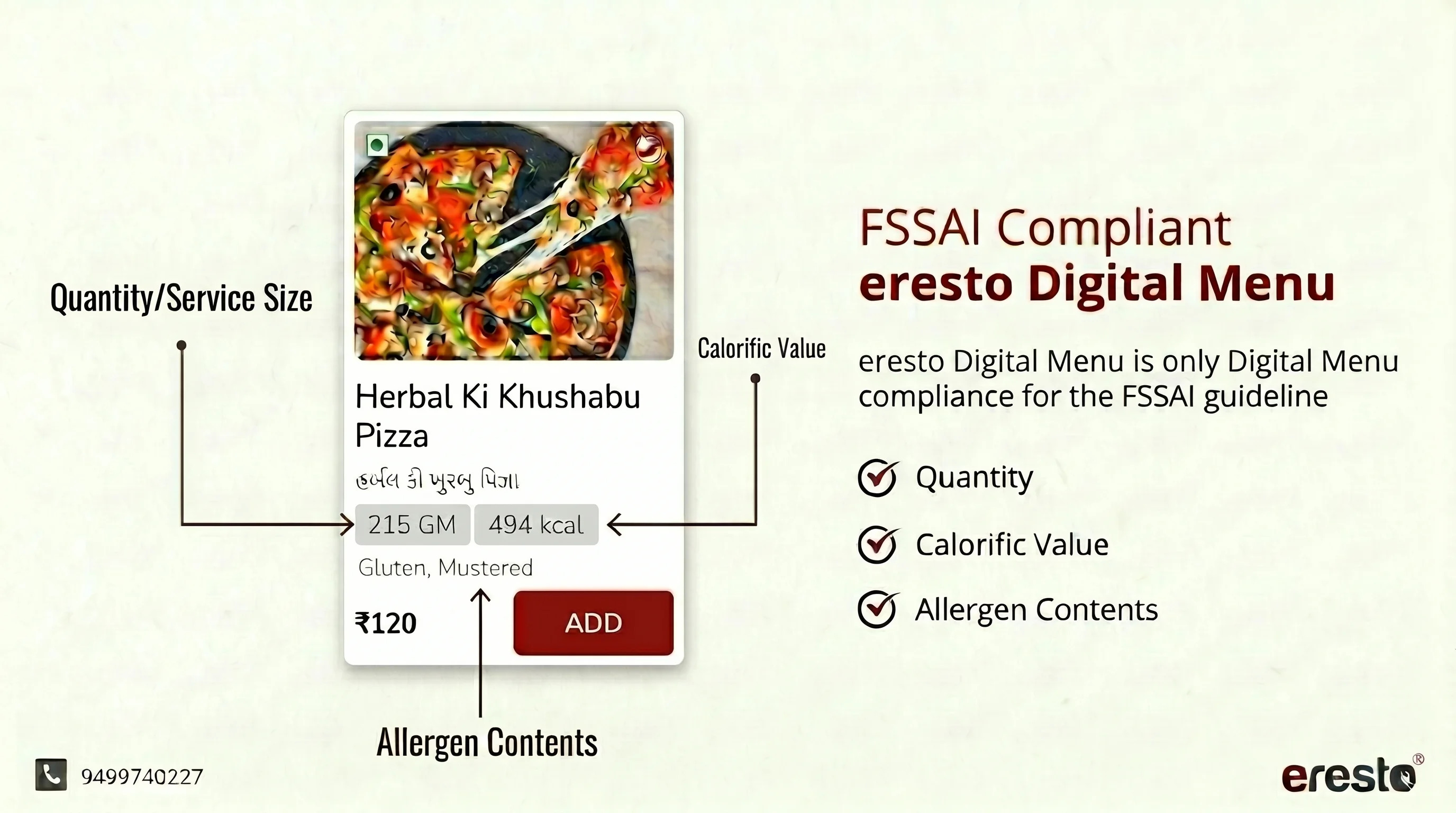
Walk into most restaurants in India and the menu tells you two things: the name of the dish and its price. But since 2022, Indian food law expects menus — printed and digital — to tell diners much more: how many calories a dish carries, how large the portion is, whether it contains common allergens, and whether it is vegetarian or not.
These requirements come from the Food Safety and Standards (Labelling and Display) Regulations, 2020, issued by the Food Safety and Standards Authority of India (FSSAI). The rules took effect on 1st January 2022, with active enforcement beginning 1st July 2022. And FSSAI has shown it is serious: within months of the deadline, it inspected hundreds of food businesses and suspended licenses of operators who ignored the norms.
This guide explains — in plain language — what the regulation actually asks for, who is legally required to follow it, and why a digital menu is the most practical way to get there.
Who Is Legally Required to Follow Menu Labelling?
This is the part most articles get wrong, so let’s be precise. FSSAI’s menu labelling mandate applies to:
- Food service establishments holding a Central FSSAI License (this includes all five-star hotels, flight and railway caterers, and large restaurant companies)
- Restaurants, clubs, canteens, cloud kitchens, and QSR chains with outlets at ten or more locations, even on a State License
- E-commerce food platforms (food delivery apps), which must obtain this information from their restaurant partners and display it on their listings
Equally important is who is exempt:
- Restaurants, clubs, and canteens on a State License with fewer than ten outlets
- Event caterers and temporary food stalls operating fewer than sixty days in a calendar year (think festival stalls and religious gatherings)
- Mid-day meal caterers, since meals there are already served against pre-determined calorific values
So if you run a single restaurant on a State License, menu labelling is not yet a legal obligation for you. But there are two strong reasons to adopt it anyway. First, the moment you grow — a Central License, a tenth outlet, a franchise model — the mandate applies to you overnight, and analysing an entire menu retroactively is painful. Second, diners increasingly expect this information, and restaurants that display it transparently earn trust that competitors don’t.
The Four Things a Compliant Menu Must Display
Whether the menu is a printed card, a wall board, a booklet, a website, or a QR-code digital menu, FSSAI requires four pieces of information on the menu itself.
1. Calorific Value — Per Serving, With the Serving Size
Every dish must show its energy value in kcal per serving, along with the serving size, placed adjacent to the dish’s name or price. “Paneer Butter Masala — ₹280” is no longer complete; the compliant version reads more like “Paneer Butter Masala — 250 g — 410 kcal — ₹280.”
The regulation is practical about accuracy: a deviation of up to 25% in the declared calorific value is tolerated, because restaurant food is hand-made, not factory-made.
2. The 2,000 kcal Reference Statement
The menu must also display, clearly and prominently, a reference line so diners can put those numbers in context:
“An average active adult requires 2,000 kcal energy per day, however, calorie needs may vary.”
FSSAI allows flexibility in the exact wording, as long as the meaning is unchanged. On a digital menu, this typically sits in the footer of every menu page.
3. Allergen Information
If a dish contains or is made from any of the following, that must be declared against the dish — either as text or as easy-to-understand symbols:
- Cereals containing gluten (wheat, rye, barley, oats, spelt and their hybrids)
- Crustaceans and their products
- Milk and milk products
- Eggs and egg products
- Fish and fish products
- Groundnut, tree nuts and their products
- Soybeans and their products
- Sulphites in concentrations of 10 mg/kg or more
For a country where nut and dairy allergies are under-diagnosed and dining out is a daily habit, this is arguably the most safety-critical requirement of the lot.
4. The Veg / Non-Veg Logo
The familiar marks — a green filled circle in a green-outlined square for vegetarian dishes, a brown filled triangle in a brown-outlined square for non-vegetarian ones — must appear in front of each dish’s name on the menu. Most Indian menus already do this; the regulation formalises it.
Two sensible exemptions apply at the dish level: free self-serve condiments that aren’t listed on the menu, and special-order or modified items prepared on a customer’s specific request, don’t need declarations.
What Must Be Available on Request
Beyond the menu itself, covered establishments must keep detailed nutritional information — energy, protein, carbohydrates (with sugar specified), and fat, per 100 g/100 ml or per serving — in a booklet, handout, website, or app, to be provided whenever a customer asks. If a dish makes a nutrition claim (“high fibre”, “high protein”), the value of that nutrient must be declared too.
There are also specific declarations for certain ingredients. Dishes with added MSG must say so (with a warning that it’s not recommended for infants under 12 months); dishes with artificial sweeteners, added caffeine, or polyols each carry their own prescribed statements. And if you claim a dish is organic, FSSAI’s organic logo and accurate organic status must back it up.
How Do Restaurants Actually Calculate Calories?
FSSAI accepts two methods:
Laboratory testing — practical for QSR and coffee chains with standardised recipes produced identically across outlets.
Calculation from credible published data — for everyone else. You list the ingredients and quantities per portion, then compute energy and nutrients using a scientifically-backed source such as the Indian Food Composition Tables, 2017 published by NIN-ICMR. The standard conversion factors are simple: protein and carbohydrates contribute 4 kcal per gram, fat 9 kcal per gram, and fibre 2 kcal per gram.
Whichever method you use, keep your calculation records (physical or digital) — Food Safety Officers can ask to see them.
Why Paper Menus Struggle With This — and Digital Menus Don’t
Here’s the operational reality: a compliant menu carries at least four extra data points per dish, and those data points change. You re-engineer a recipe, the calories change. You swap a supplier, an allergen appears. A seasonal menu arrives, and every new dish needs analysis.
On a printed menu, every such change means a reprint — across every copy, in every outlet. In practice, printed menus drift out of compliance within months.
A digital QR menu handles the same problem structurally:
- One update, everywhere, instantly. Change a calorie value or allergen tag on the dashboard and every table’s menu reflects it immediately — no reprints, no stale copies.
- Room for the data. Quantity, kcal, allergen icons, and veg/non-veg marks fit naturally on a dish card without cluttering a printed layout.
- The reference statement, always present. The 2,000 kcal line lives permanently in the menu template rather than depending on print space.
- Detailed nutrition on request, built in. The “booklet available on request” requirement is naturally satisfied when full nutritional details are one tap away on the same menu.
- Delivery-platform consistency. Since food delivery platforms must source this information from you anyway, maintaining it in one digital system keeps your dine-in menu and aggregator listings telling the same story.
One honest caveat: no software makes a restaurant compliant by itself. The regulation holds the food business responsible for the accuracy of the declared values — the calorie analysis, the allergen mapping, the records behind them. What a well-built digital menu does is make displaying and maintaining that information effortless once the analysis is done, which is where most compliance efforts quietly fail. (To see how software assists with other operational tasks, read our guide on Restaurant Management Software: What to Look for Beyond Billing).
Where eresto digiMenu Fits
We built eresto digiMenu with FSSAI’s display requirements as a first-class part of the dish card, not an afterthought: every item can show its serving quantity, calorific value, allergen contents, and veg/non-veg mark by default, across every theme — and updating any value takes seconds from the eresto Plus dashboard. Whether you’re legally covered by the mandate today or preparing for the day you will be, the display side of compliance is ready out of the box.
Want to see a compliant digital menu with your own dishes on it? Book a free demo — we’ll set it up with your menu in the same call.
Frequently Asked Questions
Is FSSAI menu labelling mandatory for every restaurant? No. It is mandatory for establishments with a Central FSSAI License or with outlets at ten or more locations, and for e-commerce food platforms listing their food. Single-outlet restaurants on a State License are currently exempt — though adopting it early builds trust and future-proofs your operations.
Does the rule apply to digital menus and websites? Yes. FSSAI’s guidance explicitly covers menu cards, menu boards, booklets, websites, digital applications, and advertising material where the menu is displayed for information or ordering.
How accurate do calorie counts need to be? The regulation tolerates a deviation of up to 25% in declared calorific value and nutritional information, recognising that restaurant portions naturally vary.
Do I need laboratory testing for every dish? No. You may calculate values from your recipes using credible published sources such as NIN-ICMR’s Indian Food Composition Tables (2017), keeping your calculation records available for inspection.
What happens if a covered restaurant doesn’t comply? FSSAI has issued improvement notices and, in escalated cases, suspended licenses of non-compliant operators — enforcement began in July 2022 and continues through routine inspections.